Transcript
Hello and welcome back. I am Josh from Nomio and I am the only person in the world who has spent the last seven years focused on just one problem, which is building and maintaining contract repositories.
Today we’re going to be talking about key person risk. This is so under-discussed in contract management. And I think it’s because no one really solves this problem.
So they pretend it doesn’t exist and sweep it under the rug. But I want to talk about it.
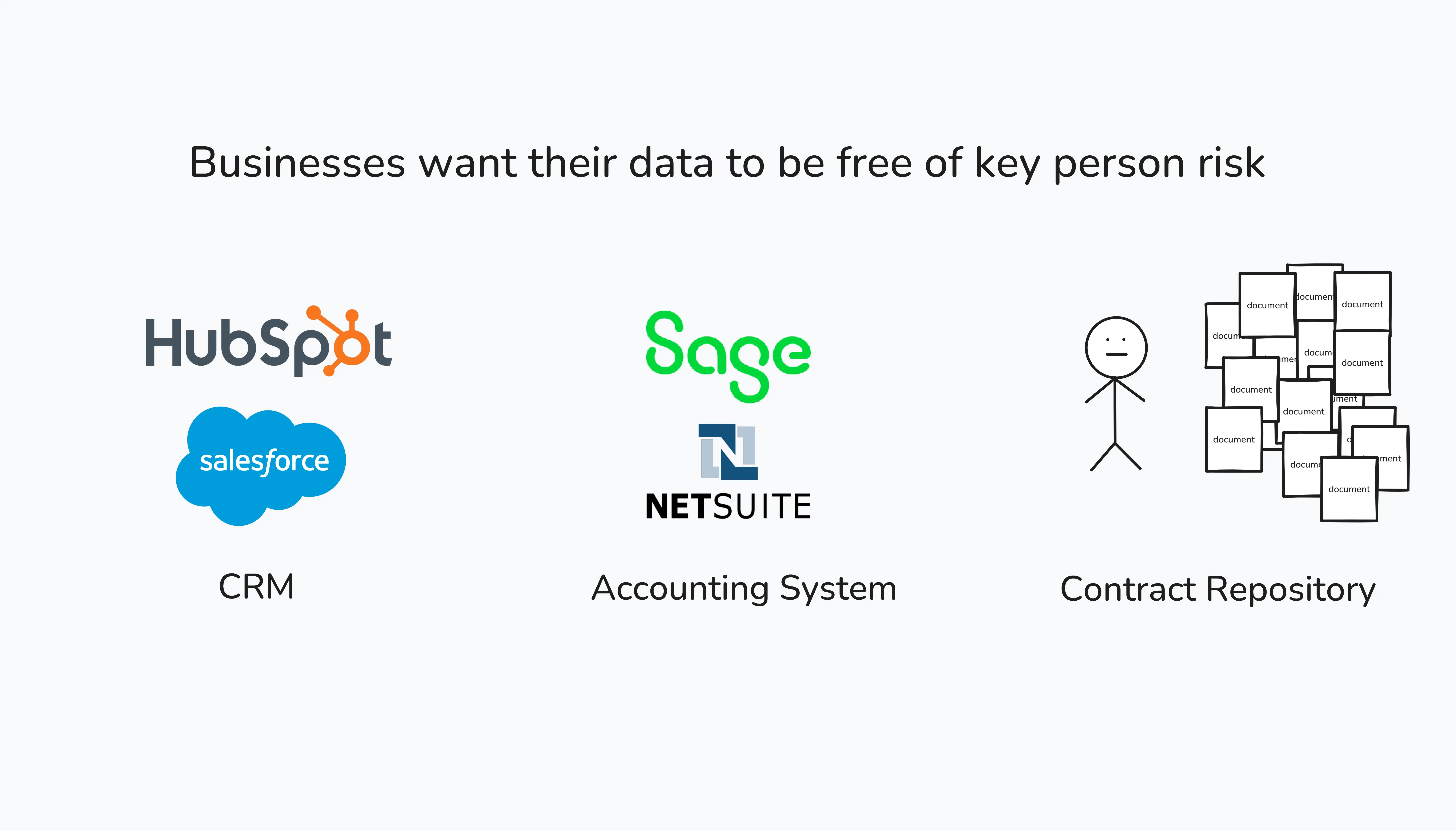
So, businesses want data. They want data that sits apart from any people. They want to know that they have a database for every important type of information in the business.
And that database is independent of whoever works on it. So for sales and commercial data, you have your CRM, all your finance data goes in an accounting system.
And then we’ve got a big pile of documents for our contracts. And unfortunately, pretty much every business is very dependent on a person or maybe a group of people to relay contract information to the rest of the business.
So, when the business has a question that relates to its contracts, whether it comes from the commercial team, the finance team, maybe even the legal team, the procurement team, we have a big problem which is that someone, whoever knows these documents best, is going to be a bottleneck.
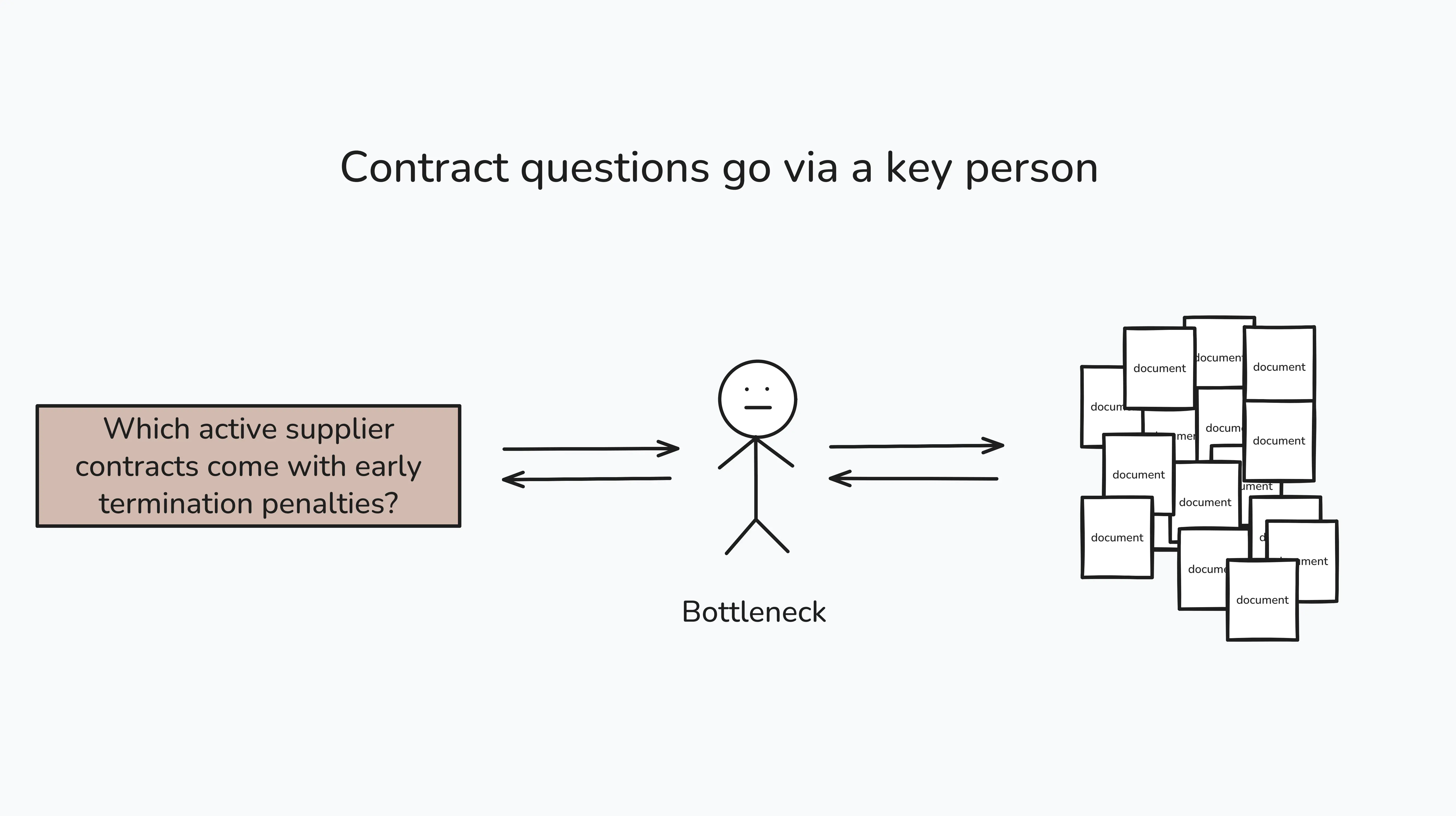
We’ve got a big mess of our contracts, kicking around a file system, no one truly knows where anything is, permissions are all over the place, so more often than not, everything is just locked down.
So, all questions have to go via a person. That person is usually very stretched themselves, if say, you’re the general counsel, you’ve got a million other things to do, and then it takes you minutes, maybe hours, to answer even the most basic questions.
Because you’ve got to go hunt down documents, you’ve got to trawl through them, you’ve got to make sure that there aren’t other amendments that might be kicking around elsewhere that have changed the information in the original, and then you’ve got to send a message back to whoever asked the question.
And you can totally forget, at this point, about being able to interact with this data in a programmatic or proactive way.
It’s purely reactive. If questions come in, you scramble to get the answer. So what a lot of people do is they try and relieve this bottleneck by building a spreadsheet or building some kind of DIY setup.
Maybe you’re manually putting data into your CRM, like Salesforce or HubSpot. Maybe you’re using SharePoint or just a standard spreadsheet.
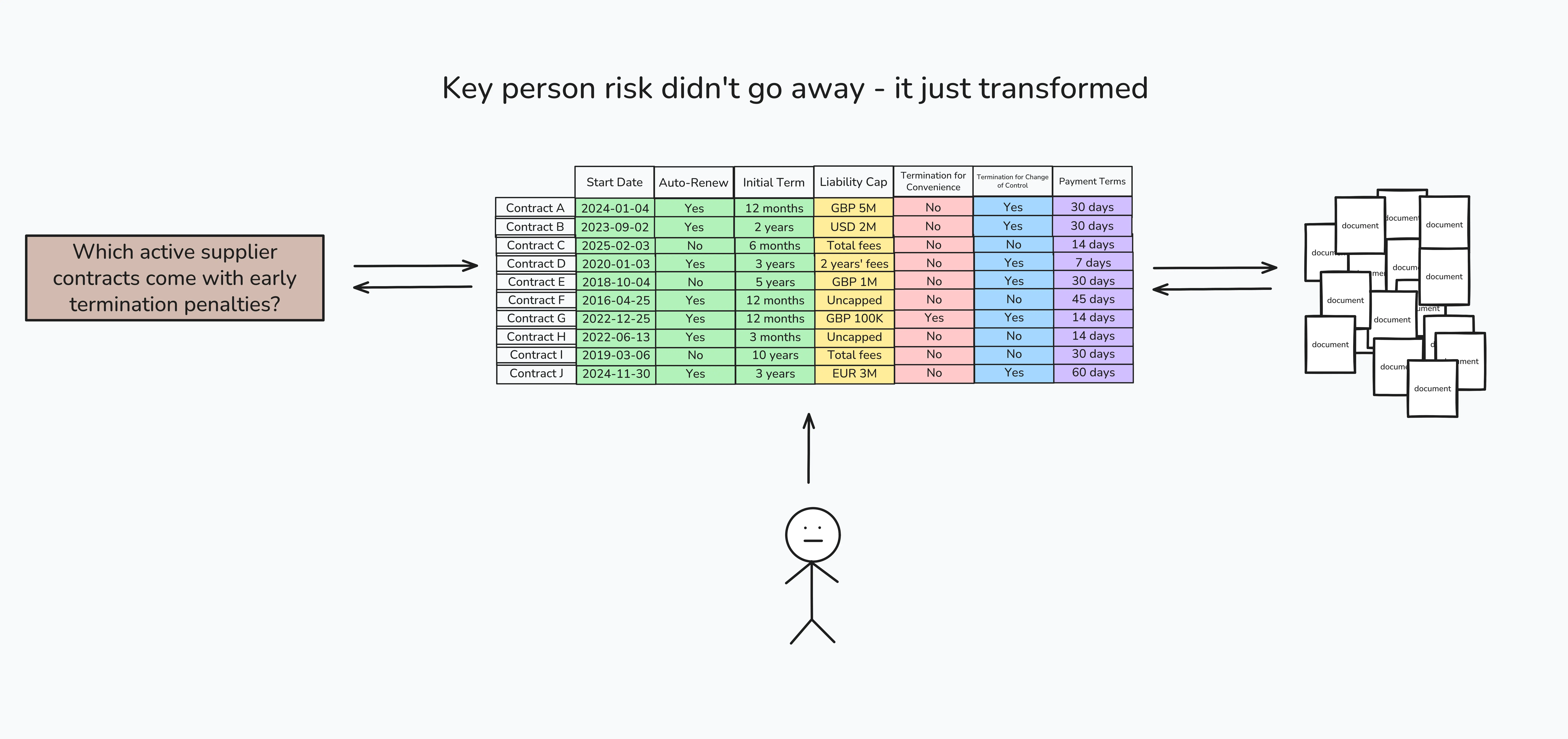
The problem is that even though the business can now ask questions about the spreadsheet, maybe people can go in and view the spreadsheet, or maybe they still have to ask someone because of permissions reasons, who then goes and looks at the spreadsheet.
You haven’t got rid of the key person risk. You’ve simply moved it from the person who stands in the way of all of the questions to the person who has to keep the spreadsheet up to date at all times, and make sure that the spreadsheet is an accurate representation of what all the documents say.
And then make sure that the spreadsheet contains all of the information that the business is asking questions about. What if suddenly we get a new type of question, that person has to go through and add a new column to the spreadsheet.
If that person leaves the business then someone else has to come in and make sure that they continue working on that spreadsheet consistently in the same way as the person beforehand.
But most likely they’re going to have a really tough time doing this because the key person responsible for maintaining the spreadsheet is probably not going to do so in a way that makes it obvious how to look after it.
So what then happens is we bring in a contract management system or a contract lifecycle management system or CLM, as they’re known, as this is a dedicated system for drafting, negotiating, signing, storing your contracts.
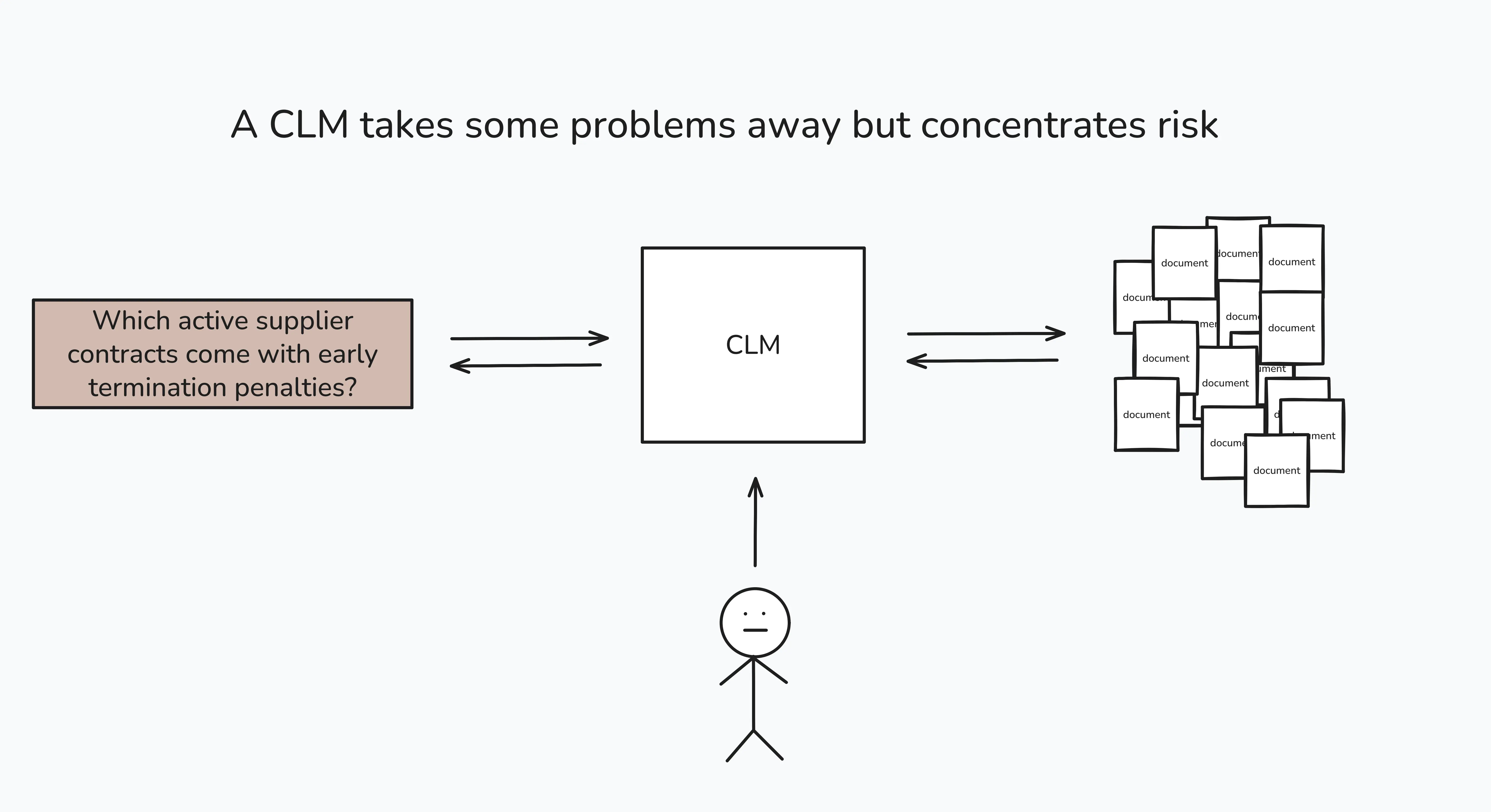
The thing is though that we’ve got to a point where although we’ve got a more and more advanced system we’ve also increased the complexity of managing the system and we’re not really any closer to removing key person risk.
All we’ve actually done is increased the stakes. We’ve got a more heavyweight system. We’ve got more moving parts. We’ve got more business processes dependent on this system and we’ve got someone who needs to be more specialised in order to manage it well.
We’ve essentially concentrated the risk into a less replaceable person than in either of the stages before. And more recently, this thing called AI, which you might be familiar with, has come onto the scene.
And I’m already speaking to a lot of people who are thinking about putting AI in front of their contracts and replacing things like a spreadsheet or a contract management system.
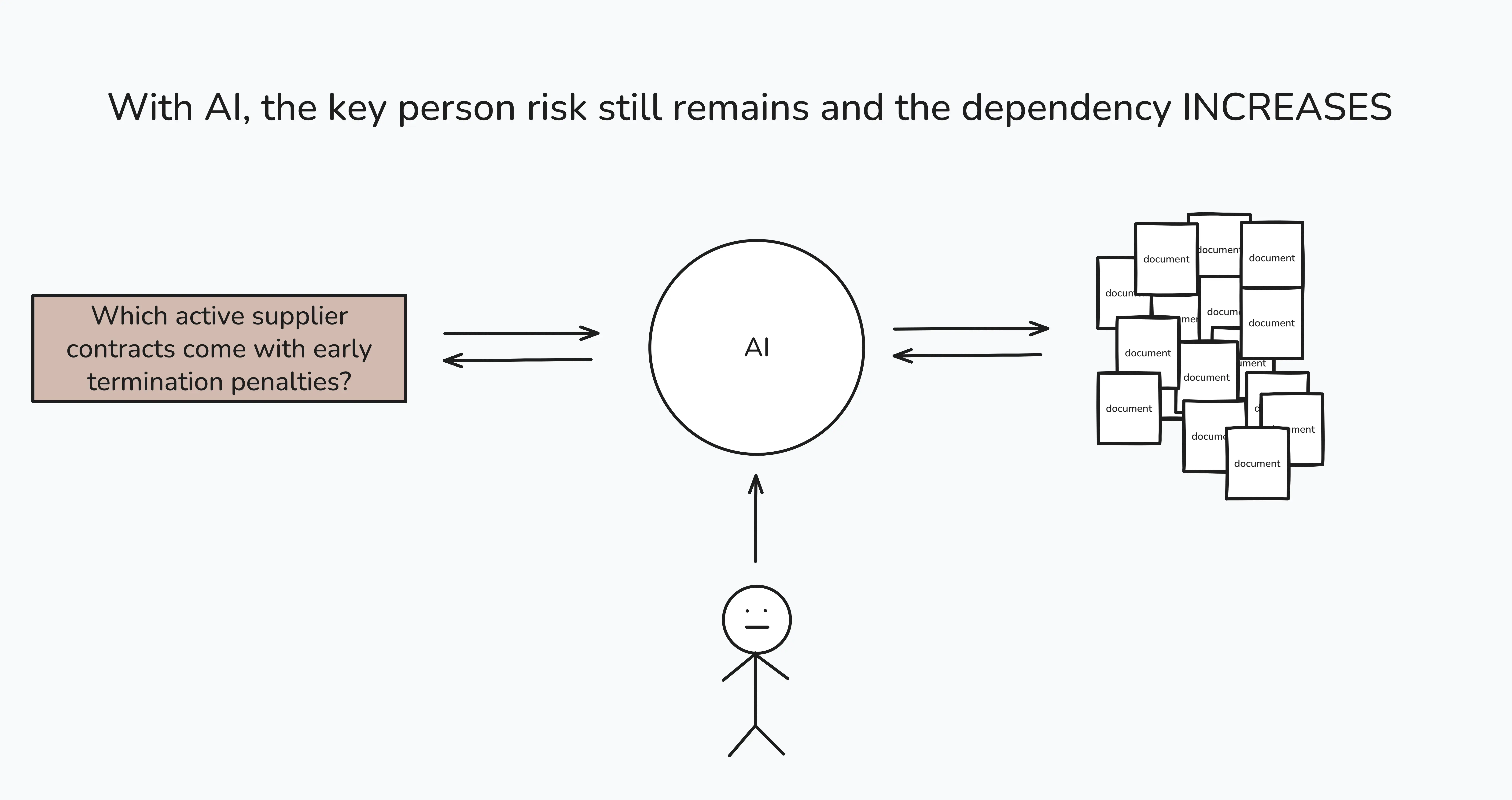
And I’ve made a bunch of videos about this, so go and check those out, if you’re interested. But the thing is, this doesn’t at all remove key person risk.
This actually makes it even worse than either of the previous scenarios. And the reason is because AI is so opaque, and it makes a whole load of mistakes, including subtle mistakes.
You need someone who sets up, configures and looks after this system and calibrates it on an ongoing basis as we escalate across the complexity spectrum, we also increase the amount of key person risk that we’re taking on.
We don’t reduce it by inserting these systems, because every time we add a system, or we increase the complexity of our system, we’re creating more and more specialised work for a person.
Our dependence on these systems grows as a business, and so we suffer a lot more if something happens to this person.
Which is why, under any of these systems, if something bad happens, like happens to this person, they go on holiday, they’re off sick, they leave the business, you’re going to be left with a big complicated system, that may work if managed, but that no one really knows how to manage.
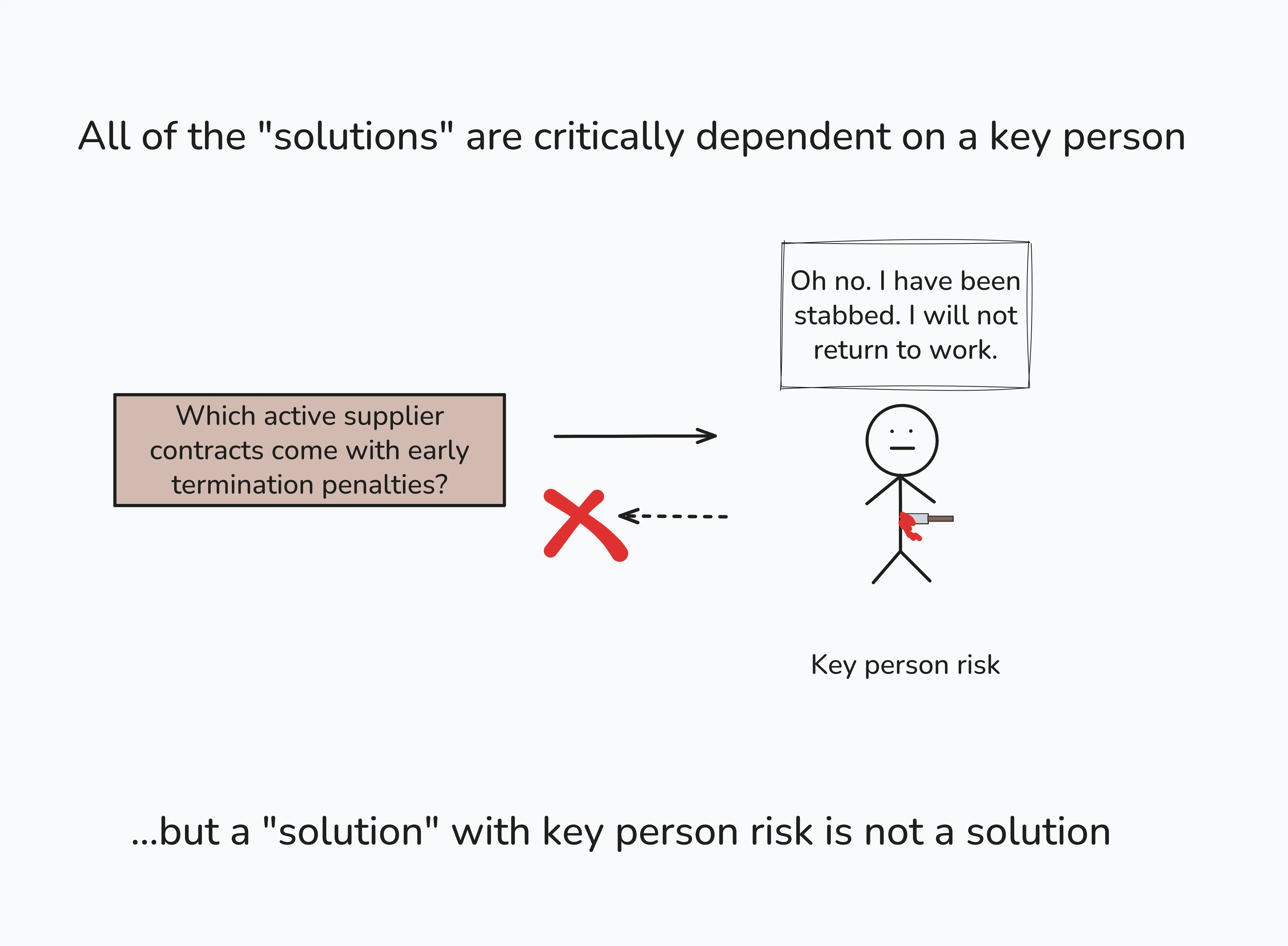
And at this point you might be wondering, okay, but how bad is key person risk, really? And in the next video I’m going to walk through exactly why it is so crushingly bad to tolerate any amount of key person risk for an asset like your contracts.
Thank you very much. Have a wonderful day. I will see you later.