






Foreword
When a Hollywood actor is fronting a global advertising campaign for a legal AI platform, you know something has changed. Jude Law’s billboards are the public face of a market that’s expected to be worth more than $70 billion within five years.
Yet despite the explosion of legal AI, there are whisperings among those who are supposed to be using it that the tech might not be living up to its promises.
I had one of those conversations with Rob Jarrett of Allegro and Size Seven, who has helped put this report together with me. We had spoken before about the same nagging feeling: AI is everywhere, but where’s the return? Why are in-house lawyers still working more hours than ever? Why do the purse strings remain tight? There seemed to be a large delta between the messages plastered across billboards and LinkedIn feeds from vendors, and what the in-house lawyers actually need.
At Nomio, we sit at the end of the contract lifecycle. We build and maintain contract repositories for organisations that too often start in the same place: contracts scattered across SharePoint, shared drives and email folders, with no reliable way of finding the information they need. The AI boom would have you believe those teams are already building agents. In reality, many are still trying to get hold of their contracts.
The paradox is that AI adoption appears to be soaring while its impact remains much harder to spot. Ironclad’s 2026 State of AI in Legal report, a survey of more than 800 legal professionals, found 92% are now using AI for legal work, up from 69% a year earlier. But using AI for what, and with what result? Aggregate numbers tell you very little about any individual lawyer’s week. And, perhaps critically, when the data and the anecdotes disagree, the anecdotes are usually right.
The anecdotes are not hard to find. This is the top post of the past year on r/legaltech:
stop trying to replace lawyers with AI by u/EconomyManner4001 in r/legaltech
So that is what we did: we followed the anecdotes.
Rather than run another anonymous survey, we set out to uncover the real experiences of the people actually doing the job. I interviewed 25 UK-based in-house lawyers, from legal counsel to general counsel, on top of countless conversations at breakfasts, dinners, and events. Nobody was interviewed because they are a customer of ours, and the overwhelming majority have no relationship with Nomio at all; we wanted a fair and balanced report, not an echo chamber.
Three groups emerged from the research. At one end were organisations already pushing the boundaries of what AI can do. Lawyers like Ben Weinberger at Rakuten Advertising, Shéa Cadogan at Circeus and Amy Cronin at Skyscanner who are building internal AI tools, automating routine work and experimenting with agents that support both legal work and the project management that comes with it. Those conversations sketch what the future of the in-house role could look like.
At the other end were teams that had barely started. Beyond Copilot, many had little time to explore an increasingly crowded legal AI market. Several spoke of something close to embarrassment: going to events, seeing what others have built, and feeling far behind.
Between those two groups sat the vast majority: lawyers who use AI every day, understand its strengths, remain cautious about its weaknesses and are still working just as hard as before.
Across the groups, one word came up more than any other in these conversations: judgement. The lawyers embracing AI review their agents’ work like a newly qualified. Others refuse to delegate it.
As Andy Figgins, General Counsel at Rezolv Energy, put it:
“What do your clients pay for? Whether you’re in house or outhouse, what do they pay for? They pay for your judgement.”
 Andy Figgins, General Counsel, Rezolv Energy
And curiously, one vendor kept coming up, too. Across the 25 interviews, Wordsmith was raised, entirely unprompted, in more than half of our conversations, with almost unanimously glowing reviews. In a market this noisy, that made it an outlier worth understanding, so we went to Wordsmith’s CEO, Ross McNairn, and asked why. You can read his perspective later on.
This report intends to give in-house lawyers a voice. It’s about how they are actually using AI, rather than how the market says they should be. Throughout the report we break down these themes, from trust and judgement to navigating the legal tech market to what lawyers think the future holds.

What the numbers tell us
There is no shortage of research pointing to AI’s growing influence on the legal profession. Surveys consistently show that in-house legal teams are embracing the technology, with new tools and use cases emerging at remarkable speed. But alongside that optimism sits a second set of figures that tells a more complicated story.
In a poll of 85 UK-based in-house lawyers, 93% said they use AI in their legal work. Yet more than half (62%) said…
they are working longer hours since adopting it. Meanwhile, almost four in five (76%) admitted they still couldn’t find every signed contract in one place.
How in-house legal teams are really using AI
These statistics should give us pause for thought. If AI is already being used by almost every legal team, why aren’t lawyers working less? And if many organisations still struggle to access one of their most important sources of legal information, are they really in a position to get the best from increasingly sophisticated AI tools?
Recent research by World Commerce & Contracting and Sirion also points to a significant gap between enthusiasm for AI and the operational foundations needed to support it, with many organisations still lacking mature contract management practices despite growing interest in AI.
Extent of software tool deployment across organisations
What in-house lawyers told us
The lawyers we spoke to work in very different organisations, from listed companies and global technology businesses to SMEs and scale-ups. Some lead teams of more than twenty lawyers. Others are the only lawyer in the business. Their experiences of AI vary enormously, but the points they raised remained remarkably consistent.
Almost everyone’s using AI. Why is nobody working less?
“AI comes along to make life easier for us. But does it really?” That’s the question Amy Cronin, Senior Director, Legal at Skyscanner, found herself asking – and it became one of the recurring themes in our interviews.
Even Pheobe Greenwood, Group General Counsel and Company Secretary, who is one of AI’s biggest advocates and calls it her “holy grail” admits her workload hasn’t decreased. Her team uses Wordsmith every day. Greenwood estimates AI has removed around 10-15% of the low-value, low-risk work from her team’s workload. The strange thing is that she’s working just as hard as before.
So is Ben Weinberger, Senior Legal Counsel at Rakuten Advertising. “I’m just spitting out more work,” he laughed when we asked him about it.
Neither lawyer sounded disappointed. Both spoke enthusiastically about what AI was enabling them to do. Yet neither felt it had made their working week any shorter.
Shéa Cadogan, Head of Legal at Circeus, however, described himself as the “exception”, having built agents and now working fewer hours as a result.
“I was in a situation where I was going to need to hire someone else. And now I’m in a situation where I have a bit of bandwidth where I don’t need to hire someone else. So it’s definitely reduced the hours.”
But for the vast majority, AI has removed repetitive work without giving back time. Those gains seem to have been absorbed almost immediately by work that had previously been sitting just out of reach.
As Moushumi Sharmacharja, Senior Legal Counsel at Global, put it:
“Work just fills up the void.”
 Moushumi Sharmacharja, Senior Legal Counsel, Global
Jamie Todd, the sole Commercial Counsel at ScreenCloud, said getting to the end of her to-do list was simply not possible, regardless of what tech she had.
“There’s absolutely no way I can do more without AI,” she said. “I need another two people probably in order to do the things that we’re doing at volume.”
AI appears to offer small wins rather than transformative change. Lawyers talked about drafting first versions more quickly, translating contracts in minutes, and finding information without digging through old files.
But the reality is that as one task becomes easier, another quickly replaces it. And as AI removes routine work, lawyers are left spending a greater proportion of their time on judgement calls, negotiations and the complex issues that technology can’t resolve on its own.
That shift should make the legal function more valuable, not less. The difficulty is proving it. Much of a lawyer’s best work happens when problems are avoided rather than solved, making it difficult for the wider business to see what legal is contributing – especially if AI creates the impression that much of the work has become automated.
As Andy Figgins, General Counsel at Rezolv Energy put it: “You’re a cost centre, you’re the department of no, you are tolerated at best. When nothing happens, that is you doing your job well. It’s really, really hard to actually demonstrate how you’re adding value. Because when you’re adding value, nothing happens.”
The armchair lawyer problem
Generative AI hasn’t just changed the way lawyers work. It’s changing the way everyone else approaches legal work, too. For the first time, people across the business have access to tools that can produce legal documents in seconds.
AI can help colleagues prepare for conversations with legal, think through commercial issues and produce a first draft before asking for help. For legal teams, that’s not necessarily a bad thing, but it isn’t necessarily making legal’s job easier either.
“I’ve had members of the exec just sending me contracts they’ve created on ChatGPT,” said Pheobe Greenwood. “Woefully inadequate.”
Greenwood doesn’t discourage people from experimenting with AI. She encourages it. What interests her is what happens when those same colleagues compare an AI-generated contract with the version produced by legal.
“You show them and you say, well this is what ChatGPT produced versus this is what we use. And they go, ‘Oh yeah… all that legal stuff, really important, it’s in there for a reason.’”
Charlotte Taylor-Evans, Group General Counsel at Quanta Group, found herself having similar conversations. As a test, she asked Copilot to draft legal documents using a bundle of source material.
“To a non-lawyer it would probably look, wow. Look at what it did.” The problems only emerged once she started questioning the output.
“You ask it to cross check the document and it says ‘Oh yes, I got that wrong.’ You’re like, ‘What else did you get wrong?’”
Rezolv Energy ran a similar experiment on a hundred-page wind turbine supply contract. The side-by-side risk comparison was good, but the judgement was not.
“It basically just said reject, reject, reject,” said Andy Figgins. “There was no subtlety at all in terms of any judgement or guidance about what our position should be given the risks that it had identified.”
As these examples show, producing legal language is one thing; understanding the nuances is something else entirely. What’s concerning is the growing assumption that because AI can produce convincing legal language, it must also be producing good legal drafting.
“Nobody really wants to pay for a PLC licence anymore because we have all of this AI,” said Taylor-Evans. “People are kind of like, ‘Oh yeah, well we can draft X document because we’ll just ask Copilot to draft one for us.’ And you think, okay, yes, it could probably give us the bare bones, but it’s never going to create something spot on for us that other lawyers have checked.”
It’s not only in-house teams using AI. Increasingly, the first draft arriving from the other side of a negotiation has been generated by a chatbot, too.
“Terms, particularly from the US, have clearly come through AI tools,” said Francesca Mohan, General Counsel at The IN Group. “They haven’t even bothered to take out the em dashes.”
That creates a new dilemma for her. “Do I improve your terms for you or not? Is that how my time should be spent?”
Oliver Storey, Head of Legal at Metro Bank, believes AI has also changed the dynamics of negotiation.
“We’ve gone from having a team of ten lawyers to a team of two and a half thousand lawyers. If you disagree with the terms the other side has sent you, you’re not just up against their lawyers any more, you’re up against Copilot too.”
 Oliver Storey, Head of Legal, Metro Bank
For Natalie Salunke, a fractional General Counsel working across multiple organisations, the rise of the armchair lawyer also represents a bigger risk – the loss of the craft.
“What makes us worth what we are paid and means that there is value in what we bring is that thinking time that isn’t generated by AI. And if you’re not spending time doing that, then all you are is a conduit to AI. You’re just the letterbox. You’re not actually practising law.”
AI can’t teach judgement
“It is like a first year, a trainee who occasionally sniffs glue.” That’s how Ben Weinberger, Senior Legal Counsel at Rakuten Advertising describes AI. In other words, it’s useful but not to be trusted with too much responsibility.
Holly Dobbins-George, Senior Legal Counsel at Uber Boat by Thames Clippers, keeps a firm rein on her AI tools by using the “Oreo cookie method” from Nada Alnajafi at Contract Nerds.
“You do a short review yourself first… then you let the AI do the cream layer… and then you do a check again. So you’ve effectively checked and checked.”
As long as tasks are extremely low risk, Pheobe Greenwood is happy to fully delegate them to AI. “I’ll be honest, I don’t check,” she said.
But the approach changes as soon as the contracts become more significant: “The big stuff I’ll put in, but I will always check.”
None of the lawyers we spoke to expected AI to replace their judgement. Instead, many described it as something much closer to a junior member of the team.
Greenwood calls it “my paralegal”. Quanta Group’s Taylor-Evans uses Copilot “a bit like a paralegal”.
ScreenCloud’s Jamie Todd also sees AI as another member of the team. It can surface information, draft wording and speed up routine work, but eventually someone still has to decide whether the contract reflects the business’s position.
“You obviously need a person, the decision making point, at some point,” she said.
But if AI is increasingly taking on the work that junior lawyers once learned from, how will the next generation develop the judgement needed to become that decision-maker?
Taylor-Evans believes that challenge is already beginning to emerge. In a previous role, she asked a newly qualified lawyer to mark up an NDA during her first week. Instead, the lawyer used AI.
“I knew she’d done it. It was very obvious she hadn’t checked it.”
Taylor-Evans printed the document, handed her a pen and sent her into a meeting room: “Go mark it up, use your brain,” she told her. The young lawyer could complete the exercise, but “she did a really bad job of it.”
The problem, said Valeria Ivasikh, Legal Director at Goji Investments, is that if you’ve never learnt to produce the work yourself, you can’t diagnose when the AI gets it wrong.
“You can vibe code a legal opinion, but then you can’t troubleshoot, you cannot explain.”
 Valeria Ivasikh, Legal Director, Goji Investments
The IN Group’s Francesca Mohan agreed that over-reliance on AI leaves lawyers exposed: “What if you get called into a meeting? AI is not going to be there for you then. You need to be able to stand on your own two feet.”
For Vicky Harris, General Counsel at Norstella, the risk arises when you start to outsource your own judgement: “I take probably seventy percent of what comes out of it and I don’t take the other thirty. I’ve got twenty-five years of experience to make that decision and make it quickly. But not everyone on my team does.”
“Judgement is going to become such a key thing,” she added. “I think for the next ten years we’re probably great. My concern is what happens beyond that without changing how we train junior lawyers.”
Not everyone saw the future quite so pessimistically. Metro Bank’s Oliver Storey has spent years building an in-house training pipeline, hiring paralegals, funding their SQE and supporting them through to qualification. Storey believes AI will change the way lawyers work, but not the need for lawyers themselves.
“Why can’t we just get rid of all lawyers and replace them with AI? The answer for me is judgement. AI can speed things up. But does it keep you safe? You still have to have lawyers, because we are ultimately there to keep the business safe. And that’s keeping the business safe from AI as well.”
For many of the lawyers we interviewed, the future isn’t about choosing between lawyers and AI. It’s about making sure lawyers remain capable of exercising the judgement that AI cannot.
Rezolv Energy is still drafting its AI usage policy, but Andy Figgins already knows the three things going in it:
-
Always use your judgement.
“Don’t just blithely copy, paste, send it out.”
-
Maintain your own capacity for critical thinking.
“Too many people are just giving up.”
-
Stop and think: do you actually need to use it?
“What are you going to use it for and how are you going to use it?”
Too busy for AI
Amy Cronin at Skyscanner has seen firsthand the benefit of AI helping her work more effectively. The difficulty is finding the time to make it happen. After spotting a daily tracker task AI could take on, she started building a tool herself.
“I started building something one evening at home, the only time I had, and I haven’t had any time to come back to it… it’s finding that time to actually do it is really difficult.” she admitted.
It’s a frustration that surfaced in different ways throughout our interviews. Everyone agreed that AI would become an increasingly important part of legal work. The challenge was finding enough space to step back from the day-to-day demands of the job to decide where it genuinely fitted.
For Maya Parmar, Senior Legal Counsel at Heywood, who works in a two-person legal team, that process can feel daunting.
“I find it quite difficult and a bit overwhelming if I’m honest. I don’t feel like I have time to look at all the different products, test them.”
After attending Crafty Fest and listening to other legal teams talk about AI, she came away with the feeling that she was already falling behind.
Holly Dobbins-George, Uber Boat by Thames Clippers, also acknowledges this struggle: “The actual book of business is just as busy as it ever was, if not busier. But then there’s this mounting pressure to be brilliant at AI as well. I’m passionate about AI and tech and their power to improve our working lives. But being on top of the tech is another role on top of our professional roles.”
It might be an unpopular opinion, but Rakuten Advertising’s Ben Weinberger believes lawyers need to stop making excuses when it comes to AI adoption.
“If your excuse is, I don’t have enough time to even trial something, I’m sorry, but the world is going to pass you by pretty fast.”
 Ben Weinberger, Senior Legal Counsel, Rakuten Advertising
Luci McAleese’s answer to this is to bring in external expertise. “I’m using an expert who knows the market inside out, who can do all of the requirements on a really granular level,” said the Director of Legal & Compliance at Attio. “I just don’t have the time to do that. There’s too much lawyering to do.”
Metro Bank’s Oliver Storey said some legal teams are also delaying decisions because the technology is evolving so quickly: “People are worried about signing up to two or three-year subscriptions.”
It’s a point echoed by Circeus’s Shéa Cadogan: “You’re looking at a contract that could be two years long. That’s quite a big commitment when every three to six months the landscape has changed.”
Neil Willson, Director of Legal Operations at Cambridge University Press and Assessment, believes uncertainty is only part of the picture. Even once a legal team has chosen a product, someone still has to make it work.
“I think some of the adoption issues that are out there are because there isn’t the services wrapper around a lot of those tools.”
 Neil Willson, Director of Legal Operations, Cambridge University Press and Assessment
Buying software, he argues, is often the easiest part. Understanding how it fits into existing processes, preparing the information it needs and embedding it into the day-to-day work of a legal team takes time that many departments simply don’t have.
And, as Global’s Moushumi Sharmacharja concluded: “If you rush to adopt the wrong thing, you basically end up with a technological equivalent of a very expensive paperweight.”
The problem isn’t the AI. It’s the data underneath.
By now, it’s easier to see where the disconnect between the legal technology market and the lawyers we spoke to comes from.
Almost everyone in our research was already using AI. Yet most were still working as many hours as before. And nearly 80% still couldn’t find all of their signed contracts in one place.
Those three findings aren’t unrelated.
The foundations come first
Much of the conversation around AI starts with the technology: which model to use, which legal AI platform to buy or which agent to build first. But the organisations making the greatest progress tended to start somewhere else. Before they thought about AI, they focused on improving the way legal worked.
At Circeus, Shéa Cadogan said AI adoption began with capability, not software.
“We’ve had compulsory training. Every single person in the company needs to know how to make their own agents and use AI.”
 Shéa Cadogan, Head of Legal, Circeus
Cambridge University Press and Assessment’s Neil Willson reached a similar conclusion from a different direction. Rather than choosing technology because it has the latest AI features, he believes legal teams should start with a much simpler question: what business problem are we actually trying to solve?
That might sound obvious, but it’s easy to lose sight of when every week brings another AI announcement, another legal agent and another promise to transform the legal function. Many legal leaders are under pressure to show they’re adopting AI, whether that pressure comes from senior management, the board or simply the pace of the market itself.
The temptation is to buy software first and work out how to use it later. Yet contract lifecycle management projects have long had a mixed record, with industry research suggesting implementation success rates are little better than a coin toss. That leaves organisations potentially committing tens (or even hundreds) of thousands of pounds before they’ve agreed what problem they’re actually trying to solve.
Instead of trying to run before they can walk, the organisations making the greatest progress are the ones that focused on building the foundations first: investing in legal operations, improving processes, building AI literacy, and creating the conditions that allow technology to succeed.
But, as we’ve learned, laying the foundations for successful AI use takes time most lawyers don’t have. Traditionally, when there’s too much work and not enough hours, the choices for in-house lawyers have been: work harder, hire someone, use a law firm or buy some tech. There’s another growing option few consider, which is the use of interim or fractional lawyers to give the necessary breathing space from the day-to-day legal work while the in-house teams think about and ready themselves for AI.
One of those foundations is contract data
One of the biggest business problems lawyers described wasn’t reviewing contracts faster. It was answering the constant stream of questions arriving from every corner of the business.
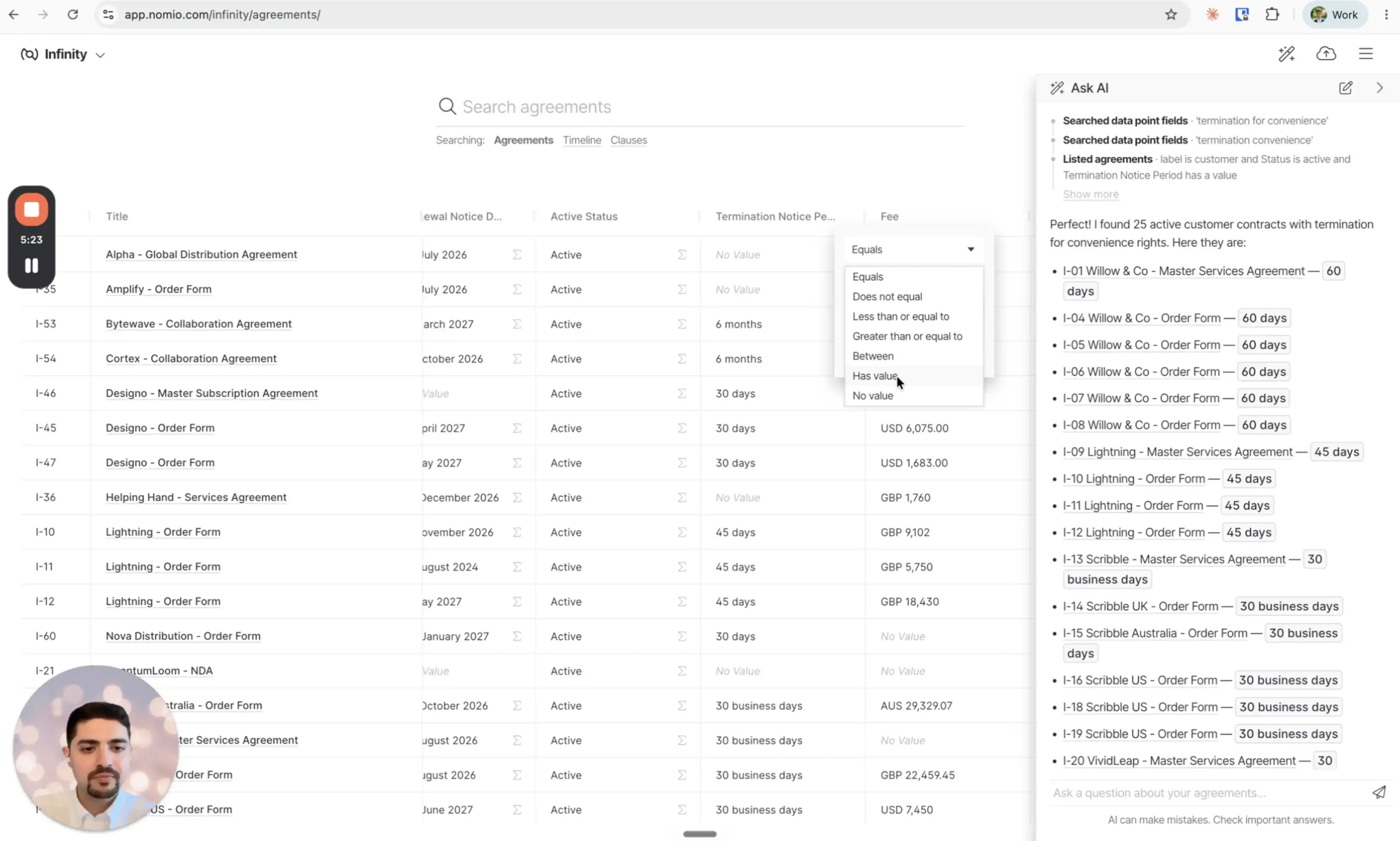
Can we terminate this agreement? What liability did we agree? When does this contract renew? Are we allowed to do this?
AI promises instant answers. But instant answers depend on having reliable information to answer from. And that’s where many organisations run into trouble.
AI is remarkably good at answering questions about a single contract. Upload one agreement to Claude or Copilot and the results are often impressive. The difficulty begins when you move from one contract to hundreds.
Most organisations don’t have a neatly organised contract database; they have documents everywhere. Every time AI is asked a question, it first has to work out which documents matter, whether they’re the latest version and how they relate to one another. The more disorganised the information, the slower, more expensive and less reliable the answer becomes.
That’s why simply pointing AI at a folder full of contracts rarely delivers the results people expect.
You can think of it as a ladder:
At the bottom are documents scattered across SharePoint, email folders and shared drives.
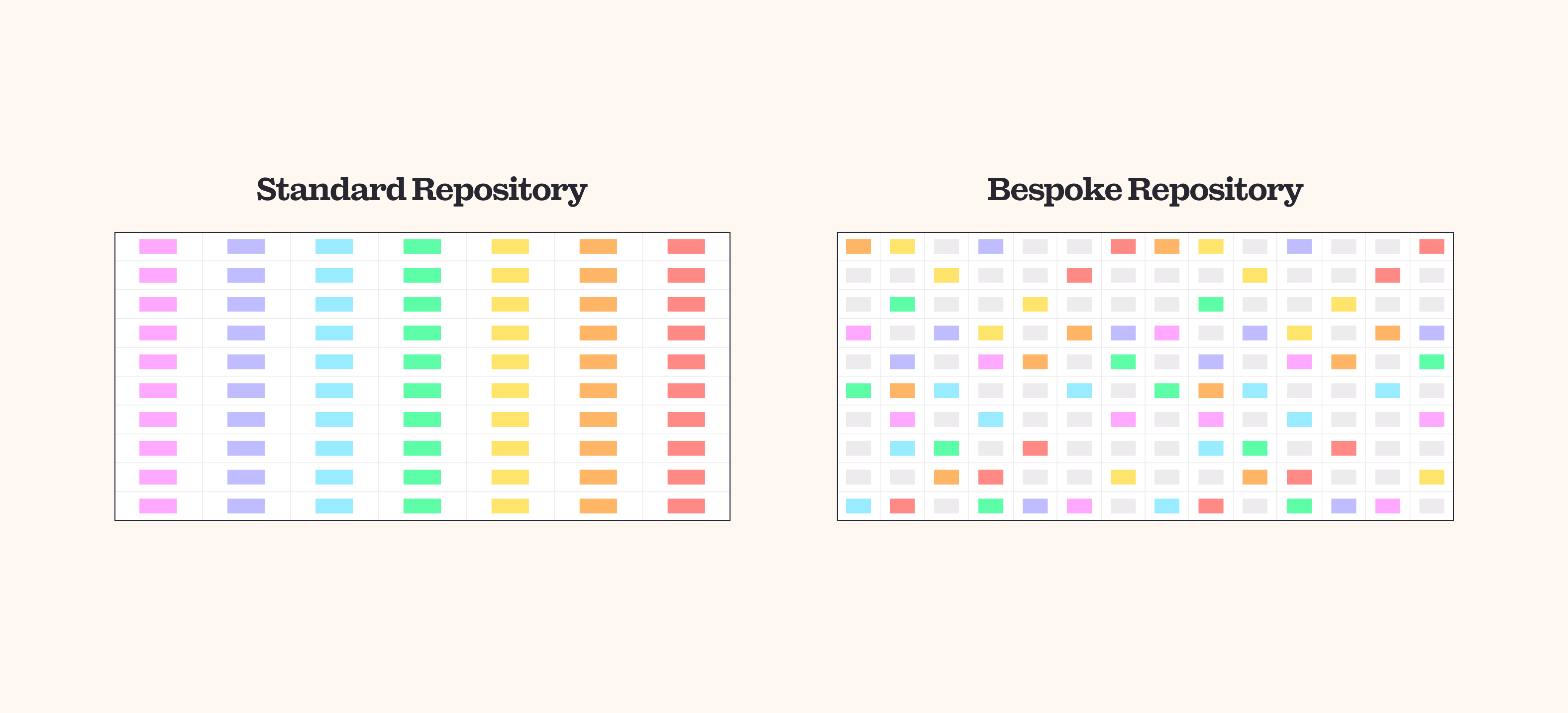
The next step on the ladder is bringing those documents together into a searchable repository.
Above that comes the harder work; validating the information inside those contracts, creating consistent processes and building reliable sources of knowledge that both people and AI can trust.
Only then do you reach the point where AI can answer questions consistently and reliably.
The problem is that many legal teams are still climbing those lower rungs while much of the market is already selling the top.
That’s why two organisations can buy the same AI software and have completely different experiences of it. Often, the difference has very little to do with the software itself. It comes down to how well the legal function has organised the information and processes that sit behind it.
The vendor perspective from Wordsmith
What the ready teams did first
Here are three organisations that have already climbed those first rungs of the readiness ladder, and what they put in place to get there.
Conclusion
Beyond a handful of organisations that have already put those foundations in place, these interviews suggest that most in-house legal teams aren’t ready for AI.
It’s not because lawyers have been slow to embrace it. Most are already using AI in some form and many couldn’t imagine working without it. They simply haven’t yet been able to realise its full potential because they haven’t had the time to build everything that sits around it.
That should be an encouraging conclusion. If AI is forcing legal teams to organise their knowledge, rethink their processes and invest in stronger operational foundations, the long-term result won’t simply be better use of AI – it will be better legal functions.
Perhaps the most surprising lesson from these interviews is that readiness doesn’t appear to be determined by the size of the legal team. Some of the most advanced examples came from large organisations with dedicated legal operations teams. Others came from a sole lawyer building AI agents in-house. The difference wasn’t headcount, it was the foundations they had put in place and the willingness to invest time in learning.
That may become even more important over the next few years. Building useful AI tools no longer requires a team of software engineers. As Shéa Cadogan points out, lawyers already spend much of their careers writing clear instructions, creating playbooks and training other people. Those exact same skills can be used to train AI.
In the end, that may be the real story of AI in in-house legal. The profession isn’t waiting for better technology. It’s learning how to use remarkably capable technology more effectively. And the lawyers best placed to do that may be those with the qualities the profession has always valued most: clear thinking, careful judgement and meticulous attention to detail.
Why we wrote this report
Last year, we carried out research to better understand the challenges facing today’s in-house legal teams by listening to the people doing the job. Unsurprisingly, lots of lawyers were talking about AI.
A year later, we wanted to revisit the conversation. How was AI being implemented and what difference was it making? One message came through more clearly than we expected. While AI is already delivering real value, many legal teams are still missing the foundations needed to get the most from it.
Nomio has always believed that good contract management comes before good contract AI. Hearing that same conclusion emerge independently from so many experienced in-house lawyers reinforced why we focus on helping organisations organise, understand and make better use of their contracts before expecting AI to transform the way they work.
If your team is still wrestling with scattered contracts, disconnected systems or the challenge of preparing for AI, we’d love to help. We can build the contract repository that gives your organisation the foundations to become truly AI ready.
This report was researched and written with Rob Jarrett, founder of Allegro and Size Seven. Throughout our conversations, one theme kept resurfacing: legal teams need breathing space before they can build the foundations for AI. That is exactly the problem Rob’s two businesses were built to solve.
Contributors
With thanks to all of the lawyers who took the time to contribute to this report. We’ll leave them with the last word. Here are their thoughts on the future of the profession and AI’s role in it.
“I don’t think you can take away that legal acumen part of risk assessment, but everything around it speeds it up.”

“We will be replaced by people that use AI if we don’t get on that bandwagon and start using it ourselves. So I think it’s important that we embrace it, but in a safe way.”
“If it’s something that can be done by somebody who isn’t legally qualified, why is legal doing it?”

“I think the underlying question that we’re all wondering is, how far are the likes of Anthropic going to try and go direct to market?”
“Frontier AI means that we’re being asked to give opinions on things that there is no legislation in place for. You’re actually guessing where the law is going to go. And in that kind of culture of uncertainty, you definitely need to have something you can trust.”
“It’s great that if they’re given an AI tool they can use it. I think that’s their superpower, quite frankly, over me. But they need to be able to not rely on it.”

“It’s getting to understand what really makes a business tick and understanding the risk appetite. It’s really getting into the commercial aspects of a business rather than just the legal.”

“You need that intake of people. You can’t just stop that because you need a future pipeline of qualified lawyers. But there’s probably going to be more pushback from clients because they’ll say, well actually the work that these guys are doing is basic work that you could just automate. So why am I paying for this? And I think that’s something that law firms are going to have to resolve.”
“It’s going to have an impact on the more junior end of the market for sure. I think there will be people, like myself, who would have taken on a paralegal. I now won’t. And so I think there will be a skills gap in the future because the junior lawyers are going to be squeezed.”

“I think it’s going to be really hard on the junior market but really good for legal ops in general. I think that skill is going to be really important.”

“There has to be a bit more presence in the way that we are delivering our services. Otherwise we’re not going to demonstrate the value of what we bring as a profession.”

“I’m relatively optimistic as long as they hold on to the fact that even when they’ve been hired as a trainee or an NQ or an apprentice, you’re being hired to think and challenge. You can’t just plug a bunch of questions in. AI is not a source of truth.”
“I’m quite excited about delegating the work that can be safely delegated to AI agents so that I can focus on the governance bigger picture.”
“As lawyers we can’t take the approach that AI does everything for us. It’s about deciding what always has to be human in the loop, what we’re comfortable automating and what our risk appetite is.”

“It’s crucial that we think like Ian Malcolm when it comes to GenAI and especially agentic AI. We mustn’t become so preoccupied with whether we could, that we don’t stop to think if we should.”

“I think it’s going to have a huge shift on lawyering. I just wrote a book recently called the ‘Death of Big Law’. AI is not the cause of that. AI is one of the pieces of that.”
“I think in house legal teams are going to start to look different because agents will become a more integral part of the team and they’ll be able to take on some of the more low level work.”

“You still need seasoned and experienced people. AI isn’t going to replace being able to jump on the phone with an irate customer or negotiate your way through a difficult situation.”